
Heavy Equipment Manufacturing – Жестокие испытания, которые должен пройти каждый экскаватор
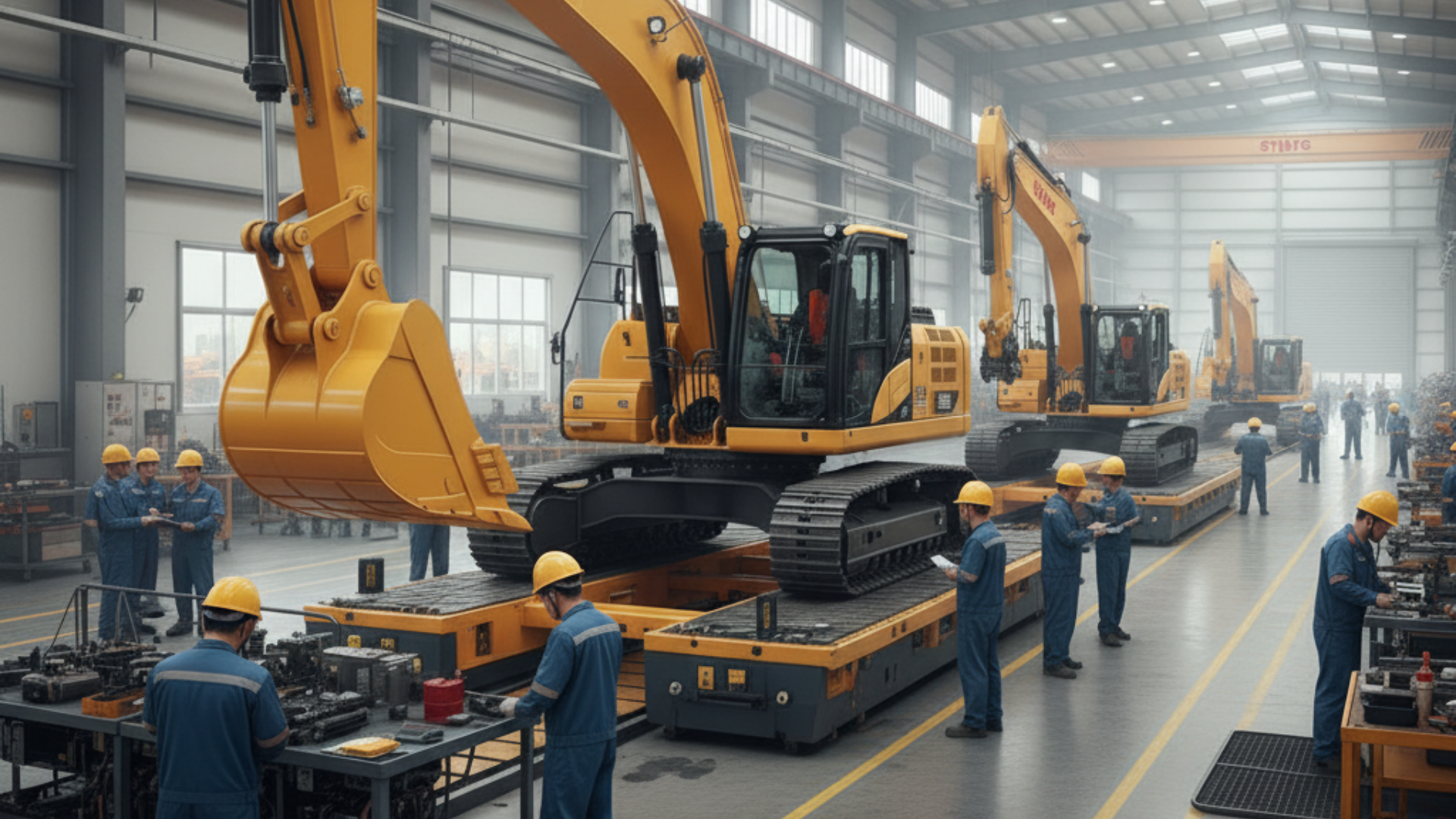
In the heavy machinery industry, the true value of an excavator is never defined by the purchase price on the invoice, but by the reliability that generates continuous revenue.
Whether it’s an iron ore mine in the Pilbara, Australia, or an oil sands project in Alberta, Canada, downtime is the enemy. When a machine stops, every hour spent waiting for parts represents a production loss of $3,000 to $8,000—not to mention the risk of missed deadlines and eroded client trust.
At sinotech group, we operate on a core belief: Reliability is not a remedy applied during inspection; it is an inevitability engineered at the source. To ensure every excavator thrives in global extremes, we enforce a dual-validation system: “Prototype Limit Testing” to engineer a DNA of durability, and “Precision Production Calibration” to eliminate manufacturing flaws.
Here are the 5 core methodologies we use to safeguard your uptime.
1. Structural Integrity: Zero-Blind-Spot NDT
The Risk: A weld may look smooth on the surface, but internal porosity, slag inclusions, or micro-cracks act as “latent time bombs.” Under thousands of excavation cycles, these defects propagate, leading to catastrophic failures like boom fractures or X-frame deformation.
Our Standard: We reject the industry-standard “visual + sampling” method. Instead, we execute 100% Non-Destructive Testing (NDT) on 6 Critical Stress Zones, including the boom root, arm articulation points, and X-frame center.
- Deep Penetration: For heavy plates (≥20mm), we use Ultrasonic Testing (UT) to scan down to the weld root, identifying micro-cracks as small as 0.1mm.
- Surface Scanning: Surface welds and high-strength components undergo Magnetic Particle Testing (MT) to capture defects invisible to the naked eye.
- Full Traceability: All inspections strictly adhere to ISO 5817 Class C standards. Data is uploaded to the cloud in real-time, traceable back to the specific welder and machine.
Zero Tolerance: Any defect triggers mandatory rework by a certified senior welder. If it fails a secondary inspection, the component is scrapped. Our quality motto is simple: “Steel has a yield limit; our standards do not.”
2. The Hydraulic Heart: Precision Matching for Peak Pressure
The Risk: Internal leakage from failed seals or pressure loss due to assembly tolerance issues causes “power drain”—fuel consumption spikes while efficiency plummets.
Our Standard: We move beyond “repair-on-fail” to a “condition-matched” global supply chain strategy.
- High-Pressure Core: For components handling 35MPa+ (Main Pump, Main Valve), we specify HNBR seals. With a temperature range of -40℃ to 120℃, their shear resistance significantly exceeds the industry average.
- Low-Pressure Security: Tanks and lines utilize top-tier FKM (Viton) seals from suppliers to eliminate seepage.
- System Health Check: During final assembly, the hydraulic system undergoes a High-Pressure Static Hold Test. We lock the system at 110% of the main relief valve setting for 30 minutes. High-precision sensors monitor the pressure—any drop exceeding 3% triggers an automatic alert and mandatory off-line troubleshooting.
3. Environmental Torture: Validating the Operating Envelope
The Risk: A machine that won’t start in the Siberian freeze or overheats in the Middle Eastern desert suffers from a design that failed to anticipate boundary conditions.
Our Standard: Before any new model enters mass production, three prototypes must complete 2,000 hours of “Extreme Cycle Testing” in our environmental simulation chamber:
- Arctic Test (-40℃): Verifies cold-start performance (≤15 seconds) and rubber elasticity, ensuring hydraulic fluid responds instantly at the freezing point.
- Desert Test (+50℃): Simulates 4 hours of continuous full-load operation to validate the thermal equilibrium system. Even with a radiator blocked by 30% dust accumulation, hydraulic oil temperatures remain within the 95℃ safety zone.
- Electronics: The ECU is stress-tested to ensure zero alarms or lag, even in 70℃ ambient heat.
Only after surviving this “hell” are prototypes certified for production. The machine you receive inherits this battle-tested DNA.
4. Operational Verification: From Lab Specs to Job Site Reality
The Risk: A machine looks great on a spec sheet but feels “clunky” or underpowered in the hands of an operator.
Our Standard: Every mass-produced unit must pass a 3-hour Full-Function Field Calibration before shipment. We let the data speak:
- Digging Force: Verified via tension sensors to ensure bucket and arm breakout forces hit 98%~102% of the rated value. No inflated specs.
- Tracking Precision: In a 50-meter straight-line tracking test, deviation is strictly controlled to ≤50cm (≤1%), ensuring safety in narrow workspaces.
- Compound Actions: Simulating veteran operator inputs (Swing + Boom Up + Arm In), we require smooth flow distribution with joystick response latency ≤0.3 seconds.
All test data generates a “Factory Performance Report” included with your machine documentation, ensuring performance is traceable and verifiable.
5. Accelerated Life Testing: Breaking Machines So You Don’t Have To
The Risk: Premature fatigue of core components leads to a wave of failures just after the warranty expires.
Our Standard: For every new platform, we designate five “Accelerated Aging Prototypes.” These machines undergo 5,000 hours of destructive testing under “Overload” conditions (120% of rated load):
- Data Acquisition: 24 stress sensors monitor metal fatigue trends on the boom and X-frame, alongside efficiency decay curves for the pump and engine.
- Feedback Loop: Any weak point exposed during testing—such as bearing wear or gear pitting—triggers an immediate design upgrade for the production models.
These prototypes are ultimately disassembled and scrapped. Their sacrifice ensures your equipment delivers an MTBF (Mean Time Between Failures) far exceeding industry benchmarks.
When you turn the key on a Sinotech Group excavator anywhere in the world, you are backed by 5 testing systems, 28 quantitative standards, and thousands of hours of data accumulation.