
La norma técnica para el tratamiento superficial de maquinaria pesada

Para maquinaria pesada que opera en minas a cielo abierto o selvas tropicales, la corrosión no es meramente un problema estético: es un asesino silencioso del valor de los activos y de la integridad estructural.
En entornos mineros de alta humedad, alta salinidad o acidez (clasificados como C5-I o C5-M según la norma ISO 12944), una pintura comercial estándar es insuficiente. Sin un tratamiento industrial de superficie, las estructuras de acero de excavadoras y cargadores sufrirán deslamación del recubrimiento en cuestión de meses, lo que provocará fatiga estructural y una caída drástica del valor de reventa.
Esta guía define los estándares de ingeniería que los equipos profesionales de adquisiciones deben verificar para garantizar la durabilidad del equipo en entornos agresivos.
Norma de preparación de superficie: ¿Por qué Sa 2.5 es el requisito mínimo?
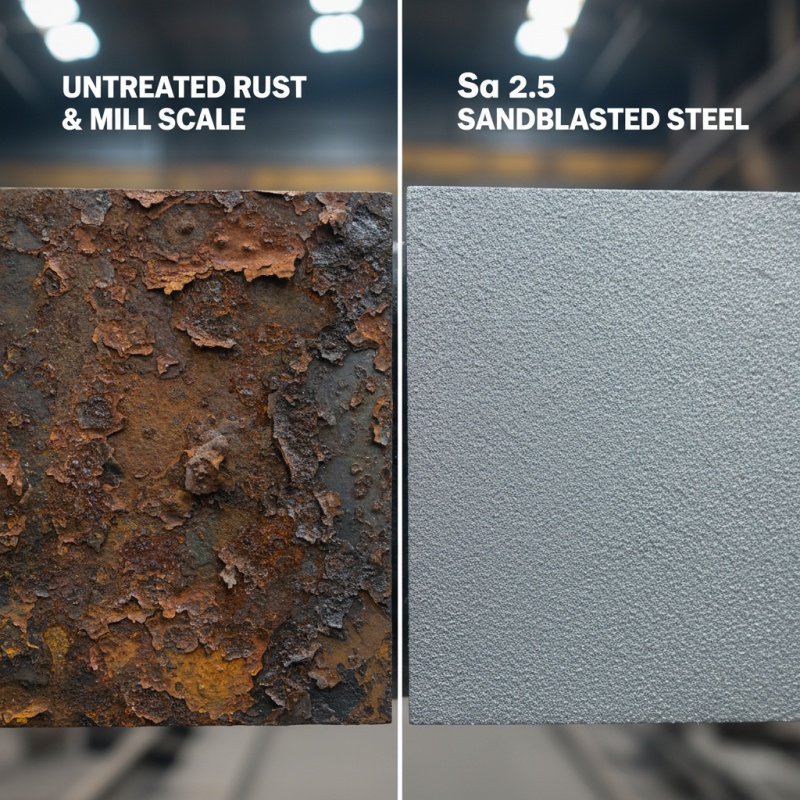
La durabilidad de un sistema de recubrimiento depende en un 70% de la preparación de la superficie. Si el sustrato de acero no se prepara adecuadamente, incluso el recubrimiento más costoso fallará.
La norma:
Para maquinaria minera, el requisito obligatorio es ISO 8501-1 Sa 2.5 (granallado casi metal blanco).
- Limpieza: El proceso debe eliminar la cascarilla de laminación, el óxido y el aceite, asegurando que el 95% de la superficie sea acero desnudo visible. El lijado manual (St 2/St 3) está estrictamente prohibido para equipos de servicio pesado.
- Perfil de anclaje (rugosidad): El granallado implica más que una simple limpieza; debe crear una rugosidad superficial microscópica.
- Norma general: Se requiere un perfil de anclaje de Rz 40–70 micras para permitir que la imprimación se “bloquee” mecánicamente en el acero.
- Norma de alto impacto: Para equipos sometidos a vibraciones intensas (p. ej., trituradoras, cargadores de roca), el perfil de anclaje debe optimizarse hasta el límite superior (Rz 60–70 micras) para maximizar la resistencia de adherencia.
Consejo de auditoría para el comprador: No baste con aceptar un “sí” respecto al granallado. Solicite un informe de ensayo de perfil de superficie para verificar que el valor Rz coincida con el uso previsto del equipo.
Sistema de recubrimiento de tres capas: composición y espesor

Para equipos expuestos a polvo abrasivo y escurrimientos químicos, una sola capa de pintura es insuficiente. Un sistema anticorrosivo conforme debe constar de tres capas químicas distintas con un Espesor total de película seca (DFT, por sus siglas en inglés) de 250–350 micrómetros (≥300 micrómetros recomendado para zonas C5-M).
Capa 1: Imprimación epoxi rica en cinc (El escudo sacrificio)
- Función: Protección catódica.
- Requisito: La imprimación debe contener polvo de cinc de alta pureza. Si el recubrimiento se rayara hasta el metal desnudo, el cinc actúa como ánodo sacrificio, corroyéndose en lugar de la estructura de acero para evitar la subcorrosión (avance de la herrumbre).
Capa 2: Intermedia epoxi con óxido férrico micáceo (La barrera)
- Función: Protección física.
- Requisito: Esta capa debe utilizar pigmentos de óxido férrico micáceo (MIO). Estas partículas en forma de escamas se alinean paralelamente al sustrato, creando un “efecto laberinto” que bloquea físicamente la penetración de agua y oxígeno en el recubrimiento.
Capa 3: Recubrimiento superior de poliuretano acrílico (La armadura)
- Función: Resistencia climática.
- Requisito: El recubrimiento superior debe ser resistente a los rayos UV para prevenir el empolvamiento (desvanecimiento) bajo luz solar intensa y poseer alta dureza física para resistir arañazos causados por piedras y desechos.
Protección para geometrías complejas: Norma de recubrimiento electroforético (E-Coating)
Los bastidores estructurales (chasis/brazos) utilizan el sistema de pulverización anterior, pero los componentes complejos de paredes delgadas (cabinas, capós de motor, soportes) requieren un enfoque distinto para evitar “zonas de sombra” donde comienza la corrosión.
La norma:
Para estos componentes, el recubrimiento electroforético catódico (E-Coating) debe usarse como imprimación base.
- Por qué es importante: El E-Coating implica sumergir la pieza en un baño de pintura electrificado, garantizando una cobertura del 100 % incluso en el interior de perfiles cerrados y cordones de soldadura.
- Integración: El E-Coating por sí solo no es suficiente para el exterior. Debe servir como base, seguida de las capas intermedia y superior, formando un sistema compuesto de “Base E-Coat + protección de 3 capas”.” Este es el único modo de garantizar una protección integral para piezas complejas.
Protocolos de verificación: Más allá de la prueba estándar de niebla salina
¿Cómo valida estas especificaciones antes de la compra? El estándar de la industria es el Ensayo de niebla salina neutra (ASTM B117 o ISO 9227). Sin embargo, para la minería, los criterios de aceptación deben ser superiores a los estándares industriales generales.
Criterios de aceptación recomendados:
| Entorno de ensayo | Duración mínima (sin ampollas/nivel de propagación de óxido) |
| Industrial estándar (C3) | 500 horas |
| Minería/marítimo (C5-M) | 000+ horas |
Verificación avanzada (la prueba definitiva):
Para minas con alto contenido de azufre o aguas subterráneas ácidas, un ensayo estándar de niebla salina puede resultar engañoso. Los compradores deben solicitar la verificación mediante el Ensayo de niebla salina acidificada (ASTM G85). Este ensayo simula la corrosión química agresiva presente en las explotaciones mineras reales, ofreciendo una predicción mucho más precisa de la vida útil del equipo.
El retorno de la inversión (ROI) del tratamiento superficial
Las especificaciones del tratamiento superficial suelen pasarse por alto en favor de la potencia del motor o la capacidad de la cuchara, aunque son el factor determinante del valor residual del activo.
Exigente Preparación Sa 2,5, un sistema multicapa de ≥300 micrones, y validación mediante ensayo de 1.000+ horas no es “sobreespecificar”; es una decisión financiera estratégica. Elimina la logística costosa de repintado in situ y garantiza que el activo obtenga un precio premium en el mercado de segunda mano tras 5 a 10 años de servicio.
Preguntas frecuentes: Referencia técnica rápida
P1: ¿Por qué es importante el perfil de anclaje (valor Rz) en el chorro abrasivo?
R1: El perfil de anclaje crea el “diente” físico al que se adhiere la pintura. Si la superficie es demasiado lisa (Rz bajo), la pintura se desprenderá bajo vibración. Para equipos mineros, un Rz de 40–70 micras proporciona la resistencia mecánica de unión necesaria para soportar ciclos de trabajo intensivos.
P2: ¿Puede el recubrimiento electroforético (E-Coating) sustituir al sistema de pintura de 3 capas?
R2: No. Aunque el recubrimiento electroforético ofrece una cobertura excelente para formas complejas, carece de la resistencia a los rayos UV y del espesor requeridos para las condiciones exteriores mineras. El estándar correcto consiste en utilizar el recubrimiento electroforético como imprimación de alta calidad y aplicar luego las capas intermedia y final sobre él para lograr la máxima durabilidad.
P3: ¿Cómo verifico si una máquina cumple con los estándares anticorrosivos C5-M?
R3: Solicite al fabricante tres documentos específicos:
- Informe de chorro abrasivo: Que confirme la limpieza Sa 2,5 y el perfil Rz de 40–70 μm.
- Hoja de especificaciones del recubrimiento: Que confirme un sistema Zinc-Rich + MIO + PU con un espesor total ≥300 μm.
- Resultados de ensayos de laboratorio: Prueba de superación de más de 1.000 horas en ensayo de niebla salina (ASTM B117).
P4: ¿Es siempre mejor una capa de pintura más gruesa?
R4: No necesariamente. Un espesor excesivo puede provocar grietas. El rango óptimo para maquinaria pesada es de 250–350 micras. Esto equilibra una protección barrera suficiente sin comprometer la flexibilidad del recubrimiento.